Physical Address
304 North Cardinal St.
Dorchester Center, MA 02124
Physical Address
304 North Cardinal St.
Dorchester Center, MA 02124

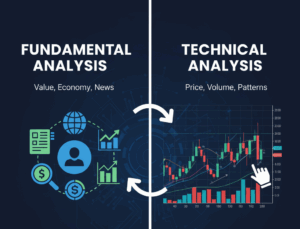
Investing in the stock market can be overwhelming, especially when deciding how to analyze stocks. There are two main approaches: fundamental analysis and technical analysis. Both aim to help traders make profitable decisions, but they work in very different ways. Understanding the differences is essential for building a strategy that matches your trading style.
Fundamental analysis is the method of evaluating a company’s intrinsic value based on its financial health, management, and growth potential. The goal is to determine whether a stock is undervalued, overvalued, or fairly priced compared to its market price.
Key components include:
A fundamental analyst believes that the market may misprice stocks in the short term, but over time, the true value of a company will reflect in its stock price. This approach is typically used by long-term investors and positional traders.
Technical analysis, on the other hand, focuses on price action, patterns, and indicators to forecast future market moves. It ignores the company’s financial statements or intrinsic value and looks only at historical price and volume data.
Key components include:
Technical analysts believe that price moves in trends and that history often repeats itself due to recurring market psychology.
| Aspect | Fundamental Analysis | Technical Analysis |
|---|---|---|
| Focus | Intrinsic value of a company | Price and volume patterns |
| Time Horizon | Long-term (months to years) | Short- to medium-term (days to weeks) |
| Data Used | Financial statements, ratios, macroeconomic data | Charts, indicators, price history |
| Purpose | Identify undervalued or overvalued stocks | Determine timing of entry/exit points |
| Tools | Earnings reports, P/E ratio, balance sheets | RSI, MACD, moving averages, support/resistance |
| Assumption | Stock price will eventually reflect true value | Price already reflects all information; patterns repeat |
| Best For | Long-term investors, value investors | Traders, swing traders, positional traders |
Yes! Many professional traders combine fundamental and technical analysis. For example:
This combination allows you to pick stocks with solid fundamentals and enter them at optimal price points, improving both safety and profitability.
Fundamental and technical analysis are not competitors—they are complementary tools. Fundamental analysis helps you choose the right stocks, while technical analysis helps you buy and sell at the right time. Understanding the difference allows traders and investors to align their strategy with their goals, whether it’s long-term wealth creation or short-term profits.
By knowing when and how to use each, you can make smarter, more disciplined decisions in the market and reduce the risk of emotional trading.